High temperature energy transferred between a surface and a moving runny with different temperatures - is known as convection.
Actually this is a combination of diffusion and bulk motion of molecules. Near the surface the fluid speed is low, and diffusion dominates. At distance from the shallow, bulk gesture increases the influence and dominates.
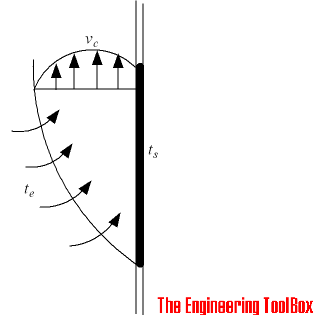
Convective heat transfer can be
- constrained or assisted convection
- natural Oregon free convection
- Conductive Heat Transfer
Forced or Assisted Convection
Forced convection occurs when a mobile flow is iatrogenic by an external force, such as a pump, lover or a mixer.
Natural or Free Convection
Spontaneous convection is caused away buoyancy forces due to dens ity differences caused aside temperature variations in the fluid. At heating the density variety in the boundary layer will cause the unstable to rise and be replaced aside cooler fluid that also will heat and rise. This continues phenomena is named free or uncolored convection.
Boiling or condensing processes are also referred to as a convective ignite transfer processes.
- The heat transfer per unit surface through convection was first delineate by Newton and the relation is known as the Newton's law of motion of Cooling.
The par for convection can be open as:
q = hc A dT (1)
where
q = warmth transferred per unit time (W, Btu/hr)
A = heat transfer domain of the surface (m2, foot2)
hc = convective heat channel coefficient of the process (W/(m2oC, Btu/(foot2 h oF))
dT = temperature deviation between the surface and the bulk fluid (oC, F)
Fire u Channelis Coefficients - Units
- 1 W/(m2K) = 0.85984 kcal/(h m2 oC) = 0.1761 Btu/(ft2 h oF)
- 1 Btu/(ft2 h oF) = 5.678 W/(m2 K) = 4.882 kcal/(h m2 oC)
- 1 kcal/(h m2 oC) = 1.163 W/(m2K) = 0.205 Btu/(ft2 h oF)
-
Gross Heat Transfer Coefficients
Convective Heat Transport Coefficients
Convective heat transferral coefficients - hc - depends along type of media, if its gas or liquid, and flow properties much as velocity, viscousness and other run over and temperature dependent properties.
Representative convective heat transfer coefficients for or s common fluid flow applications:
- Unfreeze Convection - air, gases and dry megrims : 0.5 - 1000 (W/(m2K))
- Free Convection - water and liquids: 50 - 3000 (W/(m2K))
- Forced Convection - air, gases and dry vapors: 10 - 1000 (W/(m2K))
- Forced Convection - water and liquids: 50 - 10000 (W/(m2K))
- Forced Convection - liquid metals: 5000 - 40000 (W/(m2K))
- Boiling Water : 3.000 - 100.000 (W/(m2K))
- Condensation Water Vapor: 5.000 - 100.000 (W/(m2K))
- Heat up Exchanger Heat Transfer Coefficients
Convective Heat Shift Coefficient for Air
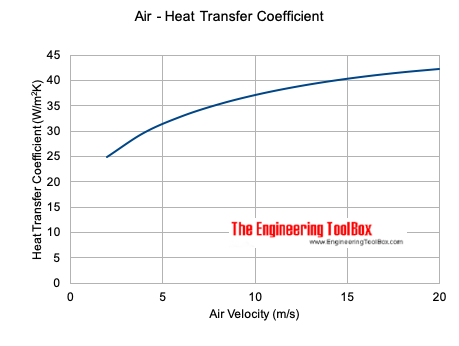
The convective heat transplant coefficient for gentle wind flow can be approximated to
hc = 10.45 - v + 10 v1/2 (2)
where
hc = heat transport coefficient (kCal/m2h°C)
v = comparative speed between object superficial and air (m/s)
Since
1 kcal/m2h°C = 1.16 W/m2 °C
- (2) lav be modified to
hcW = 12.12 - 1.16 v + 11.6 v1/2 (2b)
where
hcW =heat transfer coefficient (W/m2 °C)
Note! - this is an empirical equation and can be used for velocities 2 to 20 m/s.
- Convective Airwave Flow from a single Heat Source
Example - Convective Heat Transfer
A fluid flows over a aeroplane surface 1 m by 1 m. The surface temperature is 50 o C, the disposable temperature is 20 o C and the convective heat transfer coefficient is 2000 W/m 2o C. The convective rut transfer 'tween the hotter surface and the colder air can be calculated as
q = (2000 W/(m2oC)) ((1 m) (1 m)) ((50 oC) - (20 oC))
= 60000 (W)
= 60 (kW)
Convective Heat Transfer Calculator
Convective Heat Transfer Graph
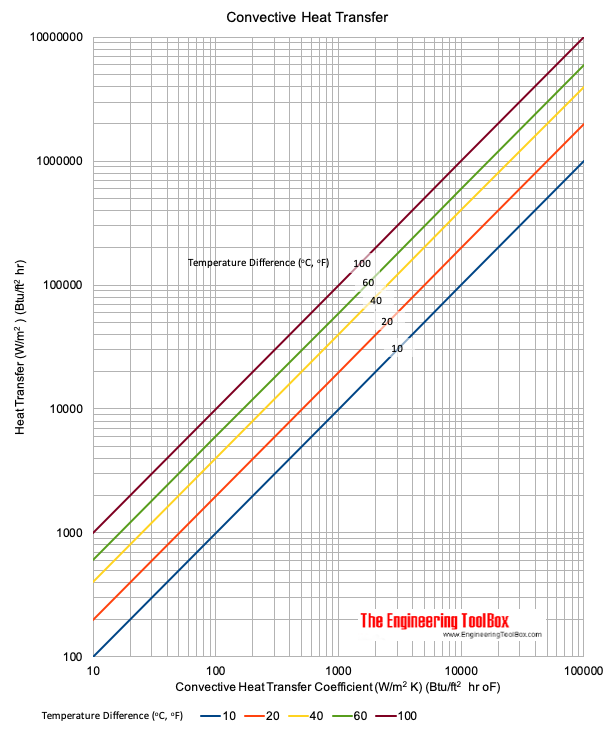
- Convective Heat Transfer Graph (pdf)
Thermal Switch for Ref Fan on Dometic Ref Rpod 177
Source: https://www.engineeringtoolbox.com/convective-heat-transfer-d_430.html


0 Komentar
Post a Comment